Evaluating the Practical Value of a Christmas Tree Vector Asset
The holiday season places unique demands on designers, marketers, and content creators. Deadlines tighten, client expectations rise, and the need for high-quality visual assets becomes immediate. In this context, relying on a well-constructed Christmas tree vector is not merely a convenience; it is a strategic decision that impacts workflow efficiency and final output quality. Unlike raster images, which are composed of fixed pixels, vector graphics are defined by mathematical paths. This fundamental difference allows for infinite scalability without any loss of resolution or clarity. For professionals who require versatility across various media formats—from large-format banners to small social media icons—understanding the utility of such an asset is essential.
This analysis explores the practical applications, technical specifications, and real-world value of a comprehensive Christmas tree vector package. By examining the included file formats—specifically EPS, SVG, and high-resolution PNGs—we can determine how this resource fits into modern design workflows and who stands to benefit most from its acquisition.
Technical Composition and File Format Utility
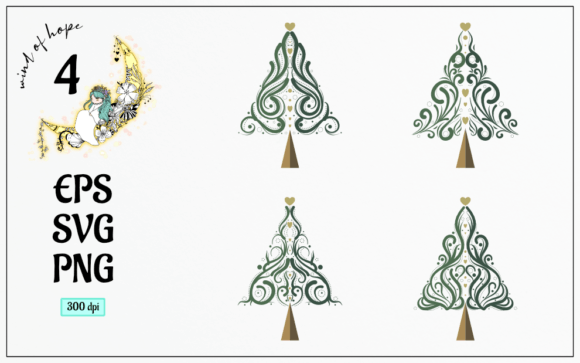
The true value of any digital design asset lies in its flexibility. A standalone image often limits a creator to a single use case. However, a diversified file package ensures that the asset can be integrated into virtually any project environment. The typical zip file associated with a premium Christmas tree vector includes four distinct format types, each serving a specific technical purpose.
The Role of EPS and SVG Files
The inclusion of an EPS (Encapsulated PostScript) file is critical for professional print workflows. EPS is a legacy vector format that remains widely supported by industry-standard software such as Adobe Illustrator, CorelDRAW, and InDesign. For users preparing materials for physical printing—such as holiday greeting cards, packaging, or promotional flyers—the EPS file ensures that the Christmas tree vector retains crisp edges regardless of the print size. It allows designers to manipulate individual anchor points, adjust curves, and modify colors to match specific brand guidelines or print requirements.
Complementing the EPS is the SVG (Scalable Vector Graphics) file. As web standards evolve, SVG has become the preferred format for digital interfaces. Unlike raster images, SVGs are code-based, making them lightweight and fast-loading. For web developers and UI designers, this means the Christmas tree vector can be embedded directly into HTML or CSS, ensuring it looks sharp on retina displays and mobile devices. Furthermore, SVGs are easily animated via CSS or JavaScript, allowing for interactive holiday elements on websites without sacrificing performance.
High-Resolution PNGs for Immediate Use
While vector files offer maximum flexibility, they require specific software to edit and view. The inclusion of four PNG files at 300 DPI with translucent backgrounds addresses the need for immediate usability. These raster images are ideal for users who may not have access to vector editing software or who need to quickly assemble a composition in tools like Canva, Microsoft PowerPoint, or basic photo editors. The 300 DPI resolution ensures that these images are suitable for high-quality printing, while the translucent background eliminates the tedious task of manual clipping or masking. This feature is particularly valuable for bloggers and social media managers who need to overlay holiday graphics onto existing photos or colored backgrounds seamlessly.
Practical Applications Across Industries
The versatility of a Christmas tree vector extends beyond traditional graphic design. Its utility spans multiple industries, each leveraging the asset’s scalability and aesthetic appeal in different ways.
- Marketing and Advertising: Agencies can use the vector to create cohesive holiday campaigns across multiple channels. The same asset can be scaled down for email headers and scaled up for billboards, maintaining brand consistency without the need for multiple design iterations.
- E-commerce and Retail: Online store owners can integrate the SVG or PNG files into their product listings, sale banners, and packaging designs. The clean lines of a vector graphic often convey a sense of professionalism and modernity, enhancing the perceived value of holiday promotions.
- Education and Publishing: Educators and publishers can utilize the EPS file to create worksheets, coloring books, or educational materials. The ability to simplify or complexify the vector paths allows for customization based on the target age group.
- Content Creation: Bloggers and influencers can use the PNGs to enhance seasonal blog posts, newsletters, and social media content. The translucent background allows for easy layering over textured or photographic backgrounds, adding a festive touch without overwhelming the primary content.
Quality, Consistency, and Long-Term Value
When evaluating a digital asset, consistency is key. A professionally crafted Christmas tree vector adheres to strict geometric principles, ensuring balanced proportions and smooth curves. This level of precision is difficult to achieve manually and is often lacking in free, low-quality alternatives. By investing in a high-quality vector package, creators avoid the common pitfalls of pixelation, jagged edges, and inconsistent styling that can detract from a project’s professionalism.
Moreover, the long-term value of such an asset cannot be overstated. Unlike trend-specific illustrations that may feel dated after a single season, a classic vector design remains relevant year after year. The ability to recolor the vector allows it to adapt to changing design trends or specific annual themes. For small business owners and freelancers, this reusability translates into significant cost savings over time. Instead of purchasing new assets every December, they can rely on a robust, adaptable foundation that serves multiple projects across several years.
Limitations and Considerations
While a Christmas tree vector offers numerous advantages, it is important to acknowledge its limitations. Vector files, particularly EPS and SVG, require a certain level of technical proficiency to edit effectively. Users unfamiliar with bezier curves or layer management may find the initial learning curve steep. In such cases, the included PNG files serve as a crucial fallback, offering a plug-and-play solution. Additionally, while vectors are excellent for flat or semi-flat designs, they may not replicate the photorealistic depth of high-end 3D renders. Creators seeking hyper-realistic textures should consider combining the vector with other graphical elements or using it as a base for further enhancement.
Final Assessment
In conclusion, a comprehensive Christmas tree vector package represents a practical and efficient resource for a wide range of creative professionals. The combination of EPS, SVG, and high-resolution PNG files ensures compatibility with both print and digital workflows, catering to diverse user needs. For those prioritizing quality, flexibility, and long-term usability, this asset provides a solid foundation for holiday-themed projects. By understanding the technical strengths and appropriate applications of each file format, users can maximize the value of their investment and streamline their creative processes during the busy holiday season.